


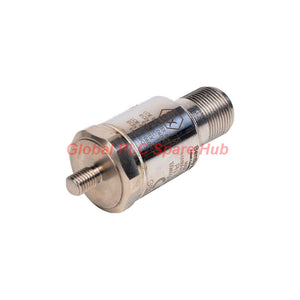

Bently Nevada 330425-02-05 Accelerometer Vibration Sensor
Manufacturer: Bently Nevada
Product No.: 330425-02-05
Condition: In stock
Product Type: Accelerometer Tranducer
Product Origin: USA
Payment: T/T, Western Union
Weight: 99g
Shipping port: Xiamen
Warranty: 12 months
Estimate delivery times: 12-26 days (International), 3-6 days (United States).
Return within 30 days of purchase. Duties & taxes are non-refundable.
Guaranteed Safe Checkout
Product Overview
Bently Nevada 330425-02-05 is a high-performance accelerometer designed for industrial machinery vibration monitoring.
This acceleration transducer measures dynamic vibration across a wide frequency range. It converts mechanical acceleration into an electrical signal with a nominal sensitivity of 100 mV/g.
The sensor supports vibration analysis on rotating machinery, including motors, pumps, compressors, turbines, and industrial equipment. Its stainless steel housing provides mechanical durability in demanding operating environments.
The integral M8 × 1 mounting stud simplifies mechanical installation. A hermetically sealed sensor case also supports operation in humid and harsh industrial environments.
Manufacturer: Bently Nevada
Model: 330425-02-05
Product Series: Industrial Accelerometer Transducers
Product Type: Acceleration Transducer
Country of Origin: Made in U.S.A.
Technical Specifications
| Parameter | Specification |
| Brand | Bently Nevada |
| Model | 330425-02-05 |
| Product Type | Accelerometer Acceleration Transducer |
| Measurement Principle | Acceleration sensing |
| Nominal Sensitivity | 10.2 mV/(m/s²), equivalent to 100 mV/g |
| Sensitivity Tolerance | ±5% |
| Acceleration Range | 490 m/s² (50 g) peak |
| Frequency Response | 10 Hz to 15 kHz, ±3 dB |
| Extended Frequency Accuracy | 30 Hz to 10 kHz, ±10% |
| Amplitude Linearity | ±1% up to 490 m/s² (50 g) peak |
| Broadband Noise Floor | 0.039 m/s² (0.004 g) RMS, 10 Hz–15 kHz |
| Temperature Sensitivity | Typically −11% to +3% across the operating temperature range |
| Transverse Sensitivity | Less than 5% of axial sensitivity |
| Mounted Resonant Frequency | Greater than 30 kHz |
| Resonant Peak Amplitude | 20 dB maximum |
| Power Supply | −24 ±0.5 VDC |
| Bias Current | 2 mA nominal |
| Output Bias Voltage | −8.5 ±0.5 VDC |
| Maximum Cable Length | 305 m (1,000 ft) without signal degradation |
| Case Grounding | Electrically isolated |
| Mounting Thread | M8 × 1 integral stud |
| Mounting Torque | 4.1 N·m (3.0 ft·lb) |
| Mounting Surface Finish | 32 μin RMS minimum surface finish |
| Mounting Orientation | Any orientation |
| Connector | 3-pin MIL-C-5015 receptacle |
| Housing Material | 316L stainless steel |
| Dimensions | 23 mm diameter × 59 mm height, including mounting stud |
| Weight | Approximately 99–100 g, without cable |
| Operating and Storage Temperature | −55°C to +121°C (−67°F to +250°F) |
| Shock Survivability | 49,050 m/s² (5,000 g) peak maximum |
| Relative Humidity | 100% condensing, nonsubmerged |
| Enclosure Protection | Equivalent to IP68 for the sensor only |
| Magnetic Field Susceptibility | Less than 2.21 mm/s²/gauss at 50–60 Hz |
| Agency Approvals | CSA, ATEX, IECEx |
| Country of Origin | U.S.A. |
Model Number Configuration
The ordering code identifies the accelerometer mounting arrangement and approval configuration.
| Code | Description |
| 330425 | Bently Nevada accelerometer model |
| 02 | M8 × 1 integral mounting stud |
| 05 | Multiple agency approvals: CSA, ATEX, and IECEx |
Complete Model: 330425-02-05
Measurement Performance and Signal Characteristics
1. Acceleration Measurement Range
- Measures peak acceleration up to 490 m/s² (50 g).
- Supports measurements within the specified 10 Hz–15 kHz frequency span.
- High-frequency vibration above 15 kHz can reduce the available acceleration range.
- Operation near sensor resonance requires particular attention to measurement limits.
2. Sensitivity and Linearity
- Nominal sensitivity reaches 100 mV/g.
- Sensitivity tolerance remains within ±5%.
- Amplitude linearity reaches ±1% up to the rated acceleration limit.
- Transverse sensitivity remains below 5% of axial sensitivity.
- The specified temperature sensitivity variation ranges from −11% to +3% typically.
3. Frequency Response and Noise Performance
- The primary frequency response spans 10 Hz–15 kHz at ±3 dB.
- The tighter response range spans 30 Hz–10 kHz at ±10%.
- The broadband noise floor reaches 0.004 g RMS across 10 Hz–15 kHz.
- The mounted resonant frequency exceeds 30 kHz.
- The maximum resonant peak amplitude reaches 20 dB.
4. Resolution and Signal Interpretation
The manufacturer specifies broadband noise rather than a digital resolution value. Actual detectable acceleration depends on the measurement system's noise floor and signal conditioning.
Engineers should evaluate sensor noise, cable characteristics, acquisition bandwidth, and signal processing settings together.
Base Strain Sensitivity and Serial Number Identification
Base strain sensitivity depends on the sensor's serial number generation. Engineers should check the serial number before selecting the mounting arrangement.
| Sensor Identification | Base Strain Sensitivity |
| Serial numbers beginning with G | 49 mm/s²/mstrain (0.005 g/mstrain) |
| Serial numbers without G, without mounting base | 980 mm/s²/mstrain (0.100 g/mstrain) |
| Serial numbers without G, with supplied API mounting base | 4.9 mm/s²/mstrain (0.0005 g/mstrain) |
Engineering Recommendation: Bently Nevada recommends using the mounting base for sensors without the G serial prefix. This arrangement significantly reduces base strain sensitivity.
For new sensors with a G prefix, the specified base strain sensitivity is substantially lower. Verify the actual sensor configuration before installation.
Installation Guide
1. Mounting Surface Preparation
- Select a rigid mounting location close to the vibration source.
- Prepare a flat mounting surface with a finish of 32 μin RMS minimum.
- Remove dirt, oil, paint, and loose particles from the contact surface.
- Check the M8 × 1 mounting thread for mechanical damage.
2. Mechanical Installation
- Align the integral mounting stud with the prepared threaded hole.
- Install the accelerometer without applying excessive side loads.
- Tighten the mounting connection to 4.1 N·m.
- Confirm firm contact between the sensor base and mounting surface.
- Choose any suitable mounting orientation according to the measurement point.
3. Electrical Connection
- Connect the sensor through its 3-pin MIL-C-5015 receptacle.
- Provide a regulated supply of −24 ±0.5 VDC.
- Allow approximately 2 mA nominal bias current.
- Verify the expected output bias voltage of −8.5 ±0.5 VDC.
- Check cable polarity and connector pin assignments against the manufacturer's wiring documentation.
- Maintain proper electrical isolation between the case and grounding system.
4. Cable Routing
- Use compatible sensor cable and connectors.
- Keep signal cables away from high-current motor and inverter wiring.
- Use suitable shielding and grounding practices.
- Observe the maximum 305 m cable length.
- Protect cable connections from mechanical damage and moisture ingress.
Commissioning and Maintenance
Initial Commissioning Checks
- Verify the model number and agency approval markings.
- Inspect the sensor housing, mounting stud, and connector.
- Confirm the mounting torque and surface condition.
- Measure the supply voltage at the sensor connection.
- Check the output bias voltage against the specified range.
- Confirm the acquisition system uses the correct sensitivity setting.
- Compare vibration readings with an independent reference instrument when necessary.
Routine Maintenance Recommendations
- Inspect the mounting connection during scheduled machinery maintenance.
- Check the connector for corrosion, contamination, or loose contacts.
- Examine cable insulation and routing for mechanical damage.
- Trend vibration measurements under consistent operating conditions.
- Investigate abnormal noise levels before changing alarm thresholds.
- Recheck sensor sensitivity settings after equipment replacement.
Diagnostic Tip: An unexpected vibration reading does not always indicate sensor failure. Check mounting stiffness, cable integrity, electrical supply, and signal conditioning first.
Environmental Protection and Electrical Interference
The 330425-02-05 supports demanding industrial environments through its sealed stainless steel construction.
- Temperature: Operates and stores within −55°C to +121°C.
- Humidity: Handles 100% condensing humidity in nonsubmerged conditions.
- Sealing: Hermetically sealed sensor case.
- Ingress Protection: Sensor protection equivalent to IP68.
- Shock: Withstands peak shock levels up to 5,000 g.
- Magnetic Interference: Susceptibility remains below 2.21 mm/s²/gauss at 50–60 Hz.
- Electrical Isolation: The sensor case remains electrically isolated.
Important: The IP68-equivalent protection applies to the sensor body only. It does not cover the external cable or connector assembly.
Do not immerse the complete cable assembly without confirming its separate environmental rating. The stated humidity capability also does not authorize submerged operation.
Compatibility and System Integration
The Bently Nevada 330425-02-05 requires a compatible acceleration measurement circuit.
- Power Supply: Regulated −24 VDC supply within the specified tolerance.
- Signal Conditioning: Compatible accelerometer input circuitry.
- Data Acquisition: Vibration monitoring equipment with suitable acceleration signal input.
- Connector: Compatible 3-pin MIL-C-5015 connection.
- Cable: Suitable sensor cable within the 305 m maximum length.
- Mechanical Interface: M8 × 1 threaded mounting point.
Confirm the input circuit's supply, bias, signal polarity, and sensitivity requirements before connecting the sensor.
Do not assume every Bently Nevada proximity monitoring module accepts this accelerometer directly. Acceleration transducers and proximity probes use different measurement principles and signal interfaces.
Certification and Approval Information
- CSA: Included in the multiple approval configuration.
- ATEX: Included in the multiple approval configuration.
- IECEx: Included in the multiple approval configuration.
- Country of Origin: Made in U.S.A.
Verify the equipment nameplate, certificate numbers, hazardous-area classification, and installation requirements before commissioning.
Approval compatibility depends on the complete installation and the applicable hazardous-area regulations.
Model Comparison: 330425-02-05 vs 330106-05-30-50-02-00
These two Bently Nevada products support machinery vibration monitoring. However, they use different sensing technologies and measure different physical parameters.
| Comparison | 330425-02-05 | 330106-05-30-50-02-00 |
| Product Type | Acceleration Transducer | 3300 XL 8 mm Reverse Mount Probe |
| Measurement Principle | Acceleration sensing | Eddy-current proximity sensing |
| Measured Parameter | Mechanical acceleration | Shaft displacement and position |
| Nominal Sensitivity | 100 mV/g | Depends on the compatible proximity system |
| Frequency Response | 10 Hz–15 kHz, ±3 dB | Depends on the complete proximity measurement chain |
| Mounting | M8 × 1 integral stud | M10 × 1 threaded reverse mount |
| Signal Interface | Accelerometer signal circuit | Proximity probe and compatible extension cable |
| Typical Application | Housing vibration and acceleration monitoring | Shaft vibration and rotor displacement monitoring |
Reference Product: 330106-05-30-50-02-00 Bently Nevada 3300 XL Reverse Mount Probe
Technical Selection Advice
- Choose 330425-02-05 for casing vibration, structural vibration, and acceleration measurements.
- Choose 330106-05-30-50-02-00 for shaft displacement and relative vibration measurements using an eddy-current proximity system.
- Use accelerometers when the measurement point requires acceleration data from a rigid machine surface.
- Use proximity probes when the application requires direct shaft-to-probe displacement measurements.
- Consider both technologies when a comprehensive machinery monitoring system requires casing and shaft vibration information.
Important Engineering Distinction: These products are not direct replacements for each other. Their mounting interfaces, electrical characteristics, and measurement outputs differ.
Global PLC Spare HUB's Insight
The 330425-02-05 provides a useful solution for high-frequency acceleration monitoring on industrial machinery.
Its 100 mV/g sensitivity supports accurate vibration signal acquisition. The 10 Hz–15 kHz frequency response also covers a broad range of machinery vibration components.
For maintenance engineers, the 0.004 g RMS broadband noise floor matters when evaluating low-level vibration signals. It helps establish the sensor's measurement noise baseline.
However, the 50 g peak acceleration limit requires attention during high-impact events. Frequencies above 15 kHz and operation near resonance can reduce the available measurement range.
Mounting quality also influences measurement accuracy. An uneven mounting surface or insufficient fastening torque can introduce unwanted mechanical response.
Another important consideration involves base strain sensitivity. Sensors without the G serial prefix benefit from the recommended API mounting base. This arrangement reduces mechanical strain interference.
For machinery protection projects, engineers should distinguish casing acceleration from shaft relative displacement. Combining accelerometers and proximity probes can provide complementary diagnostic information.
Packaging and Delivery
- 1 × Bently Nevada 330425-02-05 Accelerometer Transducer.
- M8 × 1 integral mounting stud configuration.
- Protective packaging for transportation.
Note: Connection cables, mounting accessories, signal conditioners, and power supplies are not included unless the purchase order specifies them.
Frequently Asked Questions (FAQ)
Q1: What does the Bently Nevada 330425-02-05 measure?
It measures mechanical acceleration caused by machinery vibration. Its nominal sensitivity is 100 mV/g.
Q2: What is the maximum acceleration range?
The specified maximum range reaches 490 m/s² (50 g) peak. This rating applies within the specified 10 Hz–15 kHz frequency span.
Q3: What power supply does this accelerometer require?
It requires −24 ±0.5 VDC. Its nominal bias current is 2 mA.
Q4: What does the M8 × 1 option mean?
It identifies the integral mounting stud thread. This configuration provides a threaded mechanical connection to the machine surface.
Q5: Can this accelerometer operate in high-temperature environments?
Yes. Its specified operating and storage temperature range extends from −55°C to +121°C. Check cable and connector temperature ratings separately.
Q6: Can engineers install the sensor in any orientation?
Yes. The specified mounting arrangement supports any orientation. A rigid mounting surface remains essential for accurate vibration measurements.
Q7: Why does mounting torque matter?
Incorrect torque can affect mechanical coupling and vibration response. Apply the specified 4.1 N·m mounting torque.
Q8: What should engineers check when vibration readings appear unstable?
Inspect mounting rigidity, cable connections, supply voltage, and signal conditioning. Also check electromagnetic interference and the acquisition system's input configuration.
Q9: Why does serial number identification matter for base strain sensitivity?
Units with and without the G serial prefix have different base strain sensitivity specifications. Older configurations benefit from the recommended API mounting base.
Q10: Can this accelerometer replace a 3300 XL proximity probe?
No. An accelerometer measures mechanical acceleration. A proximity probe measures shaft displacement relative to its mounting position. Select the sensor according to the required measurement principle.
Q11: How should buyers select between 330425-02-05 and 330106-05-30-50-02-00?
Choose the accelerometer for casing acceleration measurements. Choose the 3300 XL probe for shaft displacement monitoring. Consider the machine design and monitoring system requirements.
Q12: What information should buyers provide when requesting a quotation?
Provide the complete model number, quantity, application, destination country, and required approval configuration. Include the existing monitoring system model when checking compatibility.
Ordering Information
Product: Bently Nevada Accelerometer Acceleration Transducer
Model: 330425-02-05
Mounting: M8 × 1 Integral Stud
Sensitivity: 100 mV/g
Frequency Response: 10 Hz–15 kHz
Approvals: CSA, ATEX, IECEx
Global PLC Spare HUB supports industrial automation and machinery monitoring projects with professional product sourcing assistance.
Contact our sales team for pricing, availability, technical specifications, and compatibility verification.

Tags
Q: Are these parts 100% original and new?
A: Yes. Every component is guaranteed to be 100% original, brand-new, and factory-sealed. We also provide a 12-month comprehensive warranty for your peace of mind.
Q: How fast is the shipping to my country?
A: For in-stock items, we offer same-day dispatch. International express shipping (DHL/FedEx/UPS) typically delivers within 3–5 business days worldwide.
Q: Can I get a formal quotation with shipping costs?
A: Absolutely. Our sales team is ready to provide a detailed Proforma Invoice (PI) including the most competitive shipping rates for your location.
Q: Do you offer discounts for bulk orders?
A: We provide volume-based pricing for large projects or multiple-item orders. Please contact us to get our Best Price Guarantee.
12-Month Comprehensive Warranty
Every part supplied by Global PLC Spare Hub is covered by a 12-month warranty from the date of invoice.
- Coverage: Functional defects and hardware failures under normal operating conditions.
- Commitment: We provide immediate repair, replacement, or a full refund for any verified defective components to minimize your operational downtime.
Returns & Exchange Policy
We offer a 30-day return policy to ensure you receive the exact part your system requires.
- Eligibility: Returns are accepted for uninstalled items in their original, factory-sealed packaging.
- RMA Process: Please contact our support team to obtain a Return Merchandise Authorization (RMA) number before shipping.
- Fast Processing: Refunds or exchanges are processed within 3–5 business days after the returned item passes our technical inspection.
Need Technical Assistance?Not sure if this part is compatible with your system? [Consult our Engineers] before purchasing to ensure 100% compatibility.
People Also Bought


