


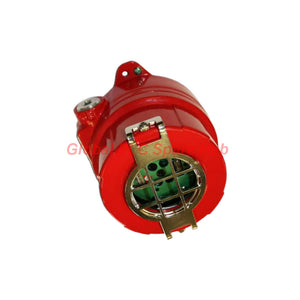

Honeywell FS20X-211-21-2 Multi-Spectrum Fire Detection Sensor
Manufacturer: Honeywell
Product No.: FS20X-211-21-2
Condition: In stock
Product Type: Fire Detection Sensor
Product Origin: USA
Payment: T/T, Western Union
Weight: 500g
Shipping port: Xiamen
Warranty: 12 months
Estimate delivery times: 12-26 days (International), 3-6 days (United States).
Return within 30 days of purchase. Duties & taxes are non-refundable.
Guaranteed Safe Checkout
Product Overview
The Honeywell FS20X-211-21-2 is a multi-spectrum UV/Dual IR/VIS flame detector. It belongs to the FS20X Flame Sentry Series. This detector combines multiple optical sensing technologies for reliable fire detection in industrial environments.
Its sensor array monitors ultraviolet, infrared, and visible radiation. The system analyzes different spectral bands to identify flame signatures. This approach helps distinguish actual fires from common environmental interference.
The UV channel provides solar-blind detection. WideBand IR, Near-Band IR, and visible sensors add spectral information. Together, these channels support rapid flame recognition and improved false alarm rejection.
The detector provides a 90-degree field of view. It can detect a 1-square-foot heptane reference fire beyond 200 feet (60 meters). Actual detection performance depends on fire type, installation conditions, and environmental factors.
Built-in RS-485 Modbus, FireBus II support, and a 4–20 mA output simplify system integration. Multiple relay outputs support fire alarm, fault, and verification functions.
Technical Specifications
| Brand | Honeywell |
| Model | FS20X-211-21-2 |
| Product Series | FS20X Flame Sentry Series |
| Product Type | Multi-Spectrum UV/Dual IR/VIS Flame Detector |
| Detection Technology | UV, WideBand IR, Near-Band IR, and Visible sensors |
| UV Spectral Band | 0.18–0.26 μm |
| Visible Spectral Band | 0.4–0.7 μm |
| Infrared Spectral Band | 0.7–3.5 μm |
| Field of View | 90-degree solar-blind field of view |
| Reference Fire Detection Range | Over 200 ft (60 m) for a 1 ft² (0.1 m²) heptane fire |
| Operating Voltage | 18–32 VDC |
| Nominal Voltage | 24 VDC |
| Analog Output | 4–20 mA, sink or source configuration |
| Digital Communication | RS-485 Modbus |
| Network Support | FireBus II |
| Relay Outputs | Alarm, fault, and verification relays |
| Enclosure Material | Copper-free aluminum |
| Conduit Entries | Two 3/4-inch NPT entries |
| Electrical Supply | 18–32 VDC |
| FM Approval | Class I, Division 1, Groups A–D; Class II, Division 1, Groups E–G; Class III |
| Other Certifications | cFM, ATEX, and IECEx compliance |
Key Technical Features
- Multi-Spectrum Detection: Combines UV, dual IR, and visible sensing channels.
- Solar-Blind UV Channel: Monitors ultraviolet radiation within the 0.18–0.26 μm band.
- Extended Detection Distance: Detects the specified heptane reference fire beyond 60 meters.
- Wide Coverage: Provides a nominal 90-degree field of view.
- Flexible Signal Interfaces: Supports 4–20 mA and RS-485 Modbus communication.
- Relay Integration: Provides alarm, fault, and verification relay functions.
- Industrial Enclosure: Uses copper-free aluminum construction for industrial installations.
Installation Guidelines
Correct positioning directly affects flame detection performance. Follow these installation practices:
- Mounting Position: Install the detector with a clear view of the protected hazard area.
- Detection Coverage: Consider the 90-degree field of view when calculating detector spacing.
- Obstruction Control: Avoid structural objects that block the optical sensing path.
- Mounting Direction: Follow the manufacturer's specified orientation and mounting instructions.
- Electrical Supply: Provide a regulated 18–32 VDC supply.
- Cable Routing: Separate signal wiring from high-voltage and high-interference circuits.
- Conduit Connection: Use the two 3/4-inch NPT entries with suitable approved fittings.
- Grounding: Follow the manufacturer's grounding and bonding requirements.
Verify hazardous-area requirements before installation. Confirm enclosure protection, conduit fittings, and cable entries against the applicable certification.
Commissioning and Maintenance
Commissioning should verify the complete detection and alarm signal chain.
- Check the supply voltage at the detector terminals.
- Inspect conduit connections, grounding, and cable terminations.
- Confirm the configured 4–20 mA output mode.
- Verify RS-485 Modbus communication with the control system.
- Check alarm, fault, and verification relay operations.
- Perform the manufacturer's approved functional test.
- Confirm alarm transmission at the fire and gas control panel.
During routine maintenance, inspect the optical window for dust, oil, and other contamination. Clean the window according to Honeywell's instructions. Check mounting stability and cable integrity.
Use an approved flame simulator or test equipment for functional verification. Never use an uncontrolled open flame during routine testing. Record test results and maintenance activities.
Compatibility and System Integration
The FS20X-211-21-2 provides several interfaces for industrial fire and gas systems.
- DCS and PLC Systems: The 4–20 mA output supports analog input integration.
- Fire and Gas Panels: Alarm and fault relays support discrete signal monitoring.
- Modbus Networks: RS-485 Modbus supports digital communication with compatible controllers.
- FireBus II Networks: Supports compatible FireBus II system configurations.
- Industrial Power Systems: Requires an 18–32 VDC supply.
Check the controller's communication protocol and input requirements before integration. Confirm Modbus addressing, wiring topology, and communication settings. Verify relay contact ratings and analog output loading against the official technical documentation.
Applications
- Oil and Gas: Monitors pump areas, processing units, and hydrocarbon handling facilities.
- Petrochemical Plants: Provides flame detection around process equipment and storage areas.
- Power Generation: Supports fire monitoring in designated equipment areas.
- Chemical Processing: Monitors hazardous production zones and process installations.
- Industrial Storage: Protects suitable fuel handling and combustible material storage areas.
Environmental and Interference Considerations
The multi-spectrum sensor architecture evaluates several optical bands. This helps improve discrimination between flame signals and environmental radiation.
However, installation conditions still influence detection performance. Consider the following factors:
- Direct sunlight and intense artificial lighting.
- Dust, smoke, oil deposits, and optical window contamination.
- Steam, water spray, and other visibility obstructions.
- Mechanical vibration and mounting movement.
- Electromagnetic interference from nearby power equipment.
Use suitable cable shielding, grounding, and routing practices. Confirm the detector's certified environmental limits before selecting it for severe operating conditions.
Certifications and Hazardous-Area Approvals
The supplied specifications identify the following approvals and compliance information:
- FM: Class I, Division 1, Groups A–D.
- FM: Class II, Division 1, Groups E–G.
- FM: Class III.
- cFM: Canadian certification identification.
- ATEX: European hazardous-area compliance.
- IECEx: International explosive-atmosphere equipment certification.
Always verify the exact certificate number, protection marking, gas group, temperature class, and ambient limits. Confirm that the approval applies to the complete FS20X-211-21-2 configuration.
Package Contents
- 1 × Honeywell FS20X-211-21-2 Flame Detector
- Standard product identification and configuration labels, where supplied
- Manufacturer documentation, where included with the shipment
Mounting brackets, cables, conduit fittings, and commissioning tools are not assumed to be included. Please confirm the required accessories when placing your order.
Frequently Asked Questions (FAQ)
Q1: What detection technologies does the FS20X-211-21-2 use?
The detector combines UV, WideBand IR, Near-Band IR, and visible sensing channels. This multi-spectrum architecture evaluates different optical signatures for flame recognition.
Q2: What is the maximum detection distance?
The specified detection range exceeds 200 feet (60 meters). This figure applies to a 1-square-foot heptane reference fire. Other fuels and installation conditions can produce different detection distances.
Q3: Can this detector connect directly to a PLC or DCS?
Yes. Its 4–20 mA output supports compatible analog input channels. RS-485 Modbus provides another integration option. Check electrical loading and communication settings before commissioning.
Q4: What should engineers check when the detector reports a fault?
Start by checking the 18–32 VDC supply and field wiring. Inspect the optical window for contamination. Then review the fault relay and communication status. Use the manufacturer's diagnostic procedure to identify the actual fault.
Q5: How should engineers position multiple detectors?
Calculate coverage using the 90-degree field of view and actual hazard geometry. Consider obstructions, mounting height, and expected fire locations. Do not calculate spacing from detection distance alone. Conduct a site-specific coverage assessment.
Q6: Does a 4–20 mA connection provide the same information as Modbus?
Not necessarily. The analog output provides a current signal according to its configured operation. Modbus provides digital communication. Review the manufacturer's interface documentation before deciding which signals your control system requires.
Q7: What should buyers confirm before ordering?
Check the complete model number, supply voltage, communication requirements, and output configuration. Confirm hazardous-area certification and conduit thread compatibility. Also verify mounting accessories and the required documentation.
Q8: Can the FS20X-211-21-2 replace another FS20X detector directly?
Not automatically. Similar model names do not guarantee identical electrical or mechanical configurations. Compare sensing technology, output interfaces, enclosure specifications, approvals, and mounting requirements before replacement.
Q9: How often should engineers inspect the detector?
Follow the site fire protection maintenance schedule and Honeywell's recommendations. Inspection frequency depends on contamination, operating conditions, and applicable safety requirements. Increase inspection attention in dusty or oily environments.
Q10: What information helps suppliers confirm the correct model?
Provide the complete part number, equipment application, required communication interface, and hazardous-area classification. Photos of the nameplate can also help confirm the configuration.
Tags
Q: Are these parts 100% original and new?
A: Yes. Every component is guaranteed to be 100% original, brand-new, and factory-sealed. We also provide a 12-month comprehensive warranty for your peace of mind.
Q: How fast is the shipping to my country?
A: For in-stock items, we offer same-day dispatch. International express shipping (DHL/FedEx/UPS) typically delivers within 3–5 business days worldwide.
Q: Can I get a formal quotation with shipping costs?
A: Absolutely. Our sales team is ready to provide a detailed Proforma Invoice (PI) including the most competitive shipping rates for your location.
Q: Do you offer discounts for bulk orders?
A: We provide volume-based pricing for large projects or multiple-item orders. Please contact us to get our Best Price Guarantee.
12-Month Comprehensive Warranty
Every part supplied by Global PLC Spare Hub is covered by a 12-month warranty from the date of invoice.
- Coverage: Functional defects and hardware failures under normal operating conditions.
- Commitment: We provide immediate repair, replacement, or a full refund for any verified defective components to minimize your operational downtime.
Returns & Exchange Policy
We offer a 30-day return policy to ensure you receive the exact part your system requires.
- Eligibility: Returns are accepted for uninstalled items in their original, factory-sealed packaging.
- RMA Process: Please contact our support team to obtain a Return Merchandise Authorization (RMA) number before shipping.
- Fast Processing: Refunds or exchanges are processed within 3–5 business days after the returned item passes our technical inspection.
Need Technical Assistance?Not sure if this part is compatible with your system? [Consult our Engineers] before purchasing to ensure 100% compatibility.
People Also Bought


